A blocked kitchen sink is usually just a local clog. A failing main sewer line is different, because every drain in the house shares that one buried pipe. When the main line is the problem, the trouble usually shows up in more than one place at once.
Here is what to watch for.
- Several fixtures back up together, say the toilet bubbles when the washing machine drains
- The lowest drains in the house, often a downstairs shower or a floor drain, back up first
- A wet patch or a sunken spot in the front yard over the pipe run, or grass that is greener there than anywhere else
- A sewage or rotten egg smell in the yard or near the foundation
- Toilet clogs that keep coming back within days of clearing them
- Gurgling from drains and toilets when water runs somewhere else
If more than one of these is happening at once, the buried main line is the likely cause, and it is worth a camera look before the next bad backup.
Studio City is full of postwar ranch and midcentury homes built in the 1940s and 1950s, and a lot of them still run on their original sewer lateral. Back then the buried line was almost always vitrified clay or cast iron. Both were normal for the time, and both have a real service life. Clay and cast iron sewer lines were generally expected to last somewhere in the 50 to 80 year range. A house built in 1948 that still has its first pipe is now past that window.
Clay pipe is strong under pressure but brittle. It comes in short sections with joints every few feet, and those joints are exactly where roots find their way in. Cast iron is tough, but it rusts from the inside over the decades. As the metal scales and flakes, the inside diameter shrinks and the pipe wall thins, and eventually a section splits along the bottom where the waste sits.
Then there is the ground here. Homes that back into the Santa Monica Mountains sit on clay heavy soil that swells in the wet winter and shrinks in the dry summer. That constant movement flexes rigid old pipe that was never meant to bend, and over time it pulls joints apart and cracks pipe walls.
Homeowners often mix up two different things, and the fix is very different for each.
The interior drain lines are the pipes inside your walls and under the slab that carry water from a single fixture, say a sink or a toilet, out to the main line. When one of those clogs, only that one fixture acts up, and it is usually cleared from a nearby drain opening.
The sewer lateral is the single large buried pipe that collects everything and carries it out of the house, under the yard, across the parkway strip by the sidewalk, and into the city main in the street. This buried lateral is the line we repair. When the lateral fails, the whole house is affected, because there is nowhere else for the waste to go.
Knowing which one is broken tells you the scale of the work. A single slow tub is a drain line call. Whole house backups and a smell in the yard point at the lateral, and that is the buried repair we specialize in.
Two things break more Studio City sewer laterals than anything else, and those are roots and ground movement.
Roots are drawn to the little bit of moisture that seeps out of a joint or a hairline crack in an old pipe. Once a fine root hair reaches that moisture it grows and thickens until it has pried the opening wider, and before long a mass of roots fills the pipe like a net that catches everything you flush. The big old sycamores and ficus and oak trees on streets near Beeman Park and Tujunga Avenue, and up on the hillsides next to Fryman Canyon, put out aggressive root systems, and clay pipe with all its joints is the easiest thing for them to get into. People ask us whether roots can crack cast iron too. They can. Roots work into a rust hole or a cracked joint in iron the same way they get into clay.
Ground movement is the other big one. Studio City’s expansive clay soil lifts and drops with the seasons, and hillside lots add slope and settling on top of that. Over the years that motion can drop a mid run section into a low spot that holds water and waste, which we call a belly, or shove two pipe sections out of line at a joint so they no longer seal. Either way they trap solids and lead to repeat backups.
We do not guess where a buried pipe is broken. We run a waterproof video camera on a flexible cable through the line from a cleanout or a pulled toilet, and we watch the inside of the pipe on a screen as it goes.
The camera shows us what we are dealing with. We can see root intrusion, cracks and offset joints, a bellied section that holds water, corrosion in cast iron, and any spot that is fully blocked. A locator on the camera head marks the exact spot and how deep it is from the surface, so if we do have to dig, we know right where to go instead of tearing up the whole yard to find it.
You see the same footage we do. That is how you know the repair matches the actual problem and not some worst case sales pitch.
There is more than one way to fix a bad lateral, and the right one depends on the pipe and the property.
Trenchless pipe lining, sometimes called cured in place pipe, pulls a resin soaked liner into the old pipe and hardens it into a new pipe formed inside the old one. It works through small access points and does not mean digging up the full length of the line. It is a strong fit when the old pipe still holds its shape and you want to protect mature landscaping and hardscape like a driveway.
Trenchless pipe bursting pulls a new pipe through the path of the old one while a bursting head breaks the old pipe outward. It replaces the line end to end without a full trench, and it is a good option when the old pipe is too far gone to line, including a lot of collapsed clay runs.
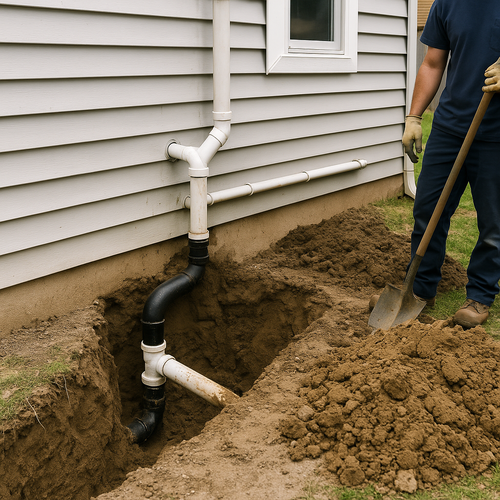
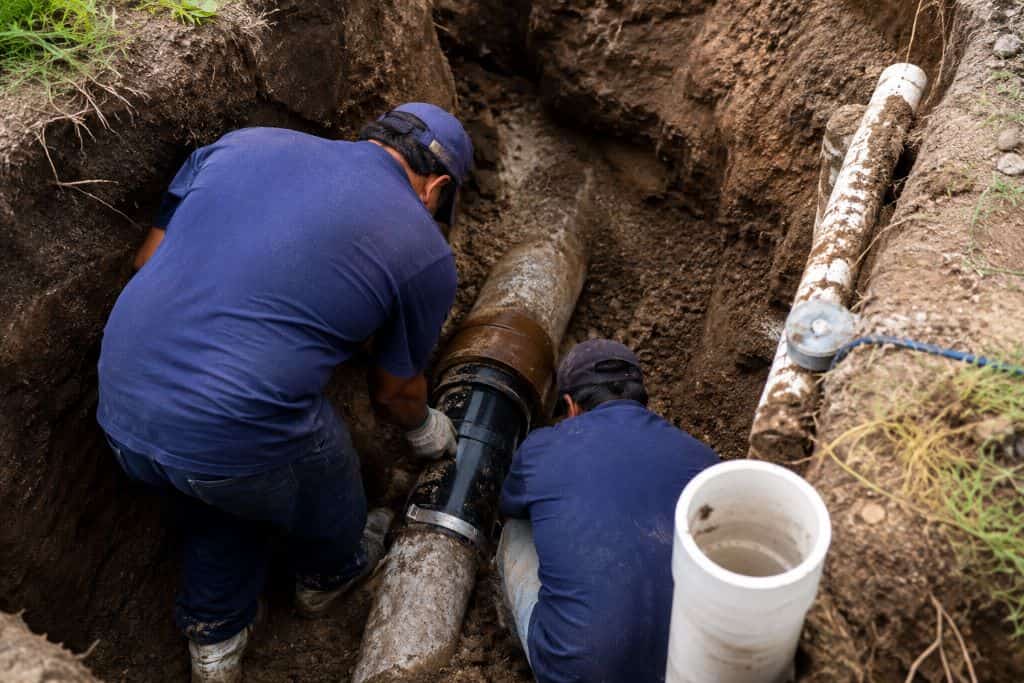
Traditional excavation opens a trench straight down to the pipe and swaps out the bad section or the whole line. It is the right call when a line is badly bellied and the grade has to be reset, or when a section has fully collapsed, or sometimes when there is just no way to get the trenchless equipment in. Studio City’s tight hillside driveways and older layouts sometimes make an open dig the practical choice.
We recommend the method after the camera inspection, not before, because the pipe itself decides what is possible.